
Full Federal Court Decision In Brady King Case Favours Taxpayers
The Full Federal Court in Brady King Pty Ltd v FCT has overturned the initial contentious judgement made by the single judge of the federal court earlier this year. The initial judgement provided a detrimental result for developers as it stipulated that there had to be a strict identity between the property acquired and the property sold in order for the margin scheme to apply. The full federal court supported a wider application of the margin scheme provisions stating that it was not essential that the property acquired should be identical to the stratum units supplied. This is a positive result for developers and is consistent with the common application of the margin scheme.
Draft GST Ruling 2008/D3
Margin scheme can be applied to partitioning agreements
The Commissioner of Taxation has recently released a draft ruling GSTR 2008/D3 which discusses the GST consequences of the partitioning of real property by joint tenants or tenants in common (co-owners). Among other things, the ruling discusses whether the margin scheme provisions can be applied to a transfer or conveyance of an interest in land under a partition.
A partitioning agreement involves the division of co-owned property through a contemporaneous transfer or conveyance by each co-owner of their respective share in a part of the property.
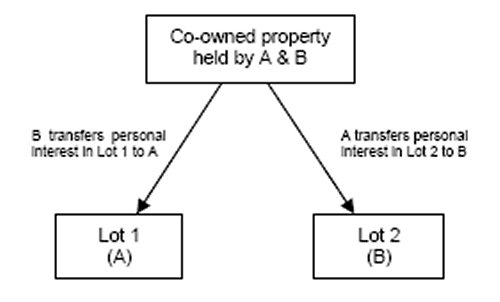
The Commissioner is of the view that a supply as defined in the GST Act arises under a partition by agreement or a court ordered partition, but not under a mere subdivision of land. Furthermore, the supply will be a taxable supply if it is made in the course or furtherance of an enterprise of the co-owner. The value of the consideration is the sum of the GST inclusive market value of other co-owner's interests in the part of the land acquired by a co-owner plus any equality money received in respect of the partition. For example, in the diagram above, the consideration A pays for Lot 1 is the GST inclusive market value of Lot 2 plus any additional money paid to B.
Furthermore, the ruling accepts that the margin scheme provisions set out in section 75 of the GST Act can be applied to a transfer or conveyance of an interest in land under a partition. The margin scheme can only apply if there is a 'selling' of a freehold interest in land, a stratum unit, or (granting) a long term lease. The Commissioner takes a broad view of the term 'selling' and states that for the purposes of Division 75, under a partition, each co-owner is 'selling' their freehold interests in land to be retained by the other co-owners.
Calculating the margin
The margin used to calculate GST liability for the supply of property under a partition will vary depending on the acquisition date of the property.
- On or after 1 July 2000: the margin will be calculated under section 75-10(2) (the amount by which the consideration for supply of each co-owners interest exceeds the consideration for the acquisition).
- Before 1 July 2000: the margin will be calculated under section 75-10(3) (the amount by which the consideration for the supply for each co-owners interest exceeds the proportion of the valuation of each co-owners interest at the prescribed valuation date).
The content of this article is intended to provide a general guide to the subject matter. Specialist advice should be sought about your specific circumstances.




