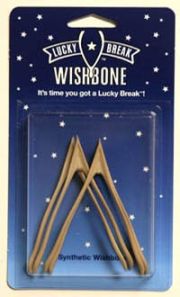
 The use of a bird's furcula, or "wishbone," for
divination purposes dates back to the ancient Etruscans, and the ritual of two people pulling
on the furcula to determine who would get married first has its origins in late medieval Europe. From there,
some version of the custom likely was brought to America by the
pilgrims, who would have referred to the bone as a
"merrythought." Given all that history, the modern
tradition of pulling the Thanksgiving turkey wishbone for luck is
hardly original.
But what about the originality of the wishbone itself? Could a
plastic wishbone sculpture, based on something found in nature,
nevertheless be original enough for copyright protection? Yes,
according to the Ninth Circuit in Lucky Break Wishbone Corp. v. Sears, Roebuck
& Co.





