Share on LinkedInShare on LinkedIn

ARTICLE · 22 AUGUST 2024

When Patent Term Adjustment Meets Obviousness-Type Double Patenting: New Insights From Allergan v. MSN

Having rejected the district court's ruling that the patents' specification failed to disclose that a glidant was optional, the Federal Circuit likewise rejected the district court's reliance on

JapanIntellectual Property

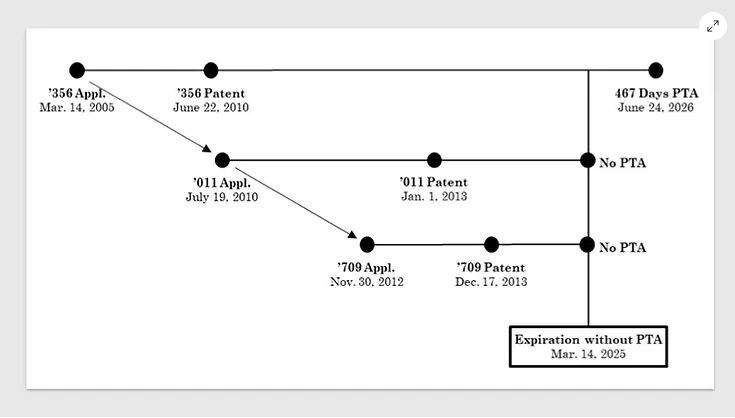
. . . In this case, the district court was confronted with just such a situation. There was no dispute that the asserted '356 patent had the same priority date as the later filed '001 and '709 patents, yet the '356 patent had a significantly longer term. . . .

1509094a.jpg

Introduction

In Allergan USA, Inc. v. MSN Laboratories, No. 2024-1061 (Fed. Cir. Aug. 13, 2024) ("Decision"), the United States Court of Appeals for the Federal Circuit addressed key issues related to the judicially-created doctrine of obviousness-type double patenting ("ODP") and written description under 35 U.S.C. § 112. Allergan appealed the District of Delaware's invalidation of its patent claims covering the drug eluxadoline, marketed under the brand name Viberzi®, which is used to treat irritable bowel syndrome with diarrhea ("IBS-D"). Specifically, the district court had held that claim 40 of U.S. Patent No. 7,741,356 ("the '356 patent") was invalid under ODP and that the asserted claims of U.S.

We operate a free-to-view policy, asking only that you register in order to read all of our content. Please login or register to view the rest of this article.

See more popular content from
