Over the past 50 years Davos has come to serve as a way station
for global capital and its partners in government. Meanwhile today,
frontier markets in Africa, the Middle East and further afield must
on the one hand grapple with constrained investor risk appetite,
and on the other reach for opportunities emerging from the
reorientation of global supply chains, tech innovation, energy
bottlenecks, and the world's decarbonisation ambitions etc.
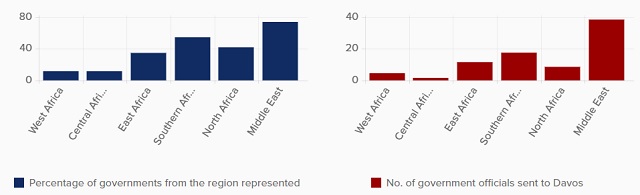
Against this backdrop, Middle Eastern officialdom appears to have
been well represented at the summit1 – at least at
a ministerial level. However, as can be seen in the below charts,
African governments have been largely absent.
There are very good reasons why the benefits of attending the
World Economic Forum (WEF) might look remote for much of Africa
right now, and the aesthetics if not the flights and accommodation
unaffordable.


