
SECURITIZATION
On 27 October 2026, the Milli Maclis considered at second reading a draft law amending the Laws, On Banks, and, On Securities Market, introducing a statutory securitization framework (new Chapter 8-2 of the Law, On Securities Market).
A company (the seller) would sell eligible receivables to a specialized securitization company, which would issue bonds serviced from collections on them. Eligible assets are claims under loans, financial leases and factoring agreements, and unlisted corporate bonds; the Central Bank may designate others. Excluded are, among others, concessional loans in cases set by regulation, claims against debtors in bankruptcy, receivables without periodic payments and assets encumbered in favor of third parties.
Each transaction needs a securitization plan approved by the Central Bank of Azerbaijan, which has 20 working days to decide. Under proposed Section 74-9, the sale agreement takes effect, and title passes to the securitization company, on plan approval; the price is paid from bond proceeds within 30 days after placement. If placement fails, the agreement terminates and title returns to the seller. If non-compliant assets are found, the seller has ten calendar days to replace them or, failing that, repurchase them. The draft therefore contemplates transfer of title upon plan approval, with payment deferred until bond-placement proceeds are received.
Once entered in the statutory register, the assets are pledged by operation of law in favor of bondholders and cannot be pledged to others or used to satisfy other creditors’ claims. This protects the portfolio against competing enforcement but not against non-payment by the underlying debtors. Bonds would generally be limited to institutional investors.
The seller must acquire at least five percent of the bonds and hold them, without disposal, until maturity; with multiple tranches under a base prospectus, this applies to the lower-rated bonds or, if unrated, those with higher credit risk. The requirement does not apply where the bonds carry a full, unconditional state guarantee or a guarantee from an international organization of which Azerbaijan is a member. The aim is to keep the seller exposed to asset performance.
The Central Bank would approve plans and supervise securitization companies and servicing agents. Securitization companies must report quarterly to the Central Bank and bondholders on receivables balances and payments. Related amendments to the Law, On Banks, would permit disclosure of banking-secrecy information to securitization companies, which must observe confidentiality.
Key issues for financial institutions: eligibility of receivables, effectiveness of transfer, servicing arrangements and the Central Bank’s implementing rules.
NEW PSA
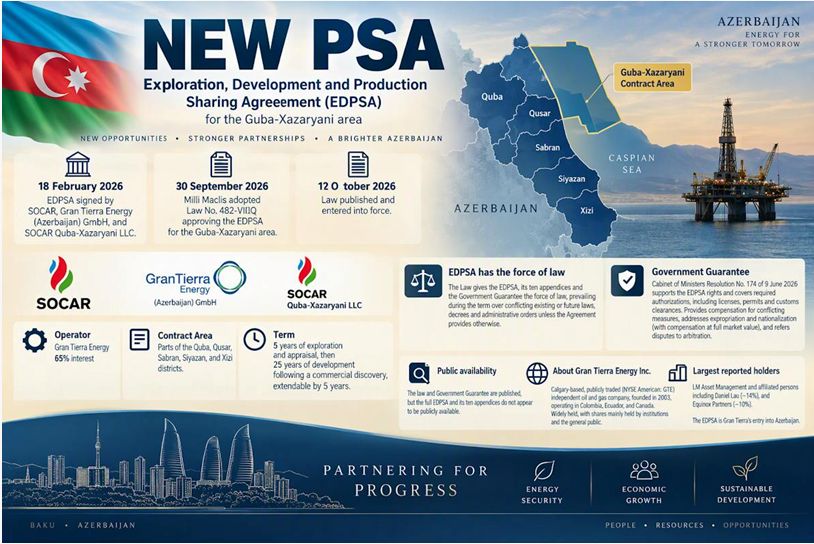
On 30 September 2026, the Milli Maclis adopted Law No. 482-VIIQ approving Exploration, Development and Production Sharing Agreement (EDPSA) for the Guba-Xazaryani area. The Law was published and entered into force on 12 October 2026.
The EDPSA was signed on 18 February 2026 by SOCAR, Gran Tierra Energy (Azerbaijan) GmbH, and SOCAR Quba-Xazaryani LLC, and covers parts of the Quba, Qusar, Sabran, Siyazan, and Xizi districts. Gran Tierra is operator with a 65 percent interest. Terms are five years of exploration and appraisal, then a 25-year development period following a commercial discovery, extendable by five years.
The Law gives the EDPSA, its ten appendices and the Government Guarantee the force of law, prevailing during the term over conflicting existing or future laws, decrees and administrative orders unless the Agreement provides otherwise. The contractor parties hold exclusive rights to conduct petroleum operations in the contract area; their rights cannot be reduced or changed without their consent, and amendments require written agreement under the EDPSA.
The Government Guarantee (Cabinet of Ministers Resolution No. 174 of 9 June 2026) supports the EDPSA rights and covers required authorizations, including licenses, permits and customs clearances. It provides compensation where conflicting measures adversely affect the contractor's protected rights or economic position, subject to its terms; addresses expropriation and nationalization with compensation at full market value; and refers disputes to arbitration.
The approving law and Government Guarantee are published, but the full EDPSA and its ten appendices, which would contain the commercial and fiscal terms, do not appear to be publicly available. Earlier flagship PSAs (ACG, Sah Daniz) were made publicly accessible years later after they were signed, whereas the recent ACG amendment has reportedly not been disclosed.
Gran Tierra Energy Inc. appears to be a Calgary-based, publicly traded (NYSE American: GTE) independent oil and gas company founded in 2003, operating in Colombia, Ecuador, and Canada. It is widely held, with shares held mainly by institutions and the general public. Its largest reported holders are LM Asset Management and affiliated persons including Daniel Lau (roughly 14 percent), and Equinox Partners (roughly 10 percent).
The EDPSA is its entry into Azerbaijan.
PROPOSED WORK PERMIT EXEMPTIONS FOR AGROPARKS
On 20 October 2026, the Legal Policy and State Building Committee of the Milli Maclis considered draft Migration Code amendments on foreign nationals employed by agropark residents. The draft passed first reading on 27 October 2026 and is not yet enacted.
Proposed Sub-Section 64.0.19-1 would exempt from work permits the heads and deputy heads of legal entities registered as agropark residents, and agronomists, horticultural specialists and veterinarians they recruit who have relevant professional experience.
A corresponding amendment to Sub-Section 45.1.7-1 would let eligible foreign nationals and stateless persons obtain temporary residence permits. Press reports describe these as long-term permits, with the special rules running from 1 January 2027 to 1 January 2032; the exact permit terms depend on the final text.
The Migration Code already has similar exemptions for certain technology park personnel. The extension would remove a separate work permit step but not the need for temporary residence permits or other immigration requirements.
The content of this article is intended to provide a general guide to the subject matter. Specialist advice should be sought about your specific circumstances.


