
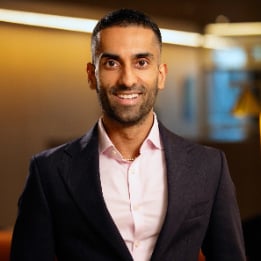
Chief Legal Officer & Group Company Secretary | Unilever

Prakash Kakkad
Chief Legal Officer & Group Company Secretary | Unilever
What are the key projects you have been involved in over the past twelve months?
Two portfolio transformations have defined the past year for me.
The first was the separation and listing of the Ice Cream business, which completed last year. In my then role as General Counsel, Corporate and Deputy Group Secretary, I led the legal and governance work facilitating the transaction. It was a complex global separation and our responsibility was not simply to complete a transaction, but to help establish The Magnum Ice Cream Company as an independent listed business while ensuring that Unilever emerged simpler, more focused and positioned for future growth. I’m extremely proud that we achieved this.
Since becoming Chief Legal Officer and Group Company Secretary in March, a major focus has been the Unilever Foods/McCormick combination. I lead Legal’s work towards completion. The ambition is compelling: to create a scaled global flavour powerhouse with strong brands, complementary capabilities and enhanced growth potential, while reshaping Unilever as a more focused, higher-growth pureplay Home and Personal Care business. Our intended outcome is two stronger, faster-growing businesses, each better aligned to its markets, capabilities and value-creation model. I’m excited to help make that happen.
Please provide a brief description of any internal transformation or development projects within your legal team over the last twelve months.
As a member of the Legal Leadership Team before becoming CLO, I was closely involved in the function’s response to Unilever’s wider productivity programme and the evolution of our operating model. Our constant aim is to simplify how we operate, reduce duplication and create greater capacity for our lawyers to focus on strategic advice, business partnering and the issues where their judgement creates most value. As we continue to evolve, our Legal Powerhouses, which bring together global support for routine and process-driven work, remain central to that evolution.
Having been part of the Legal Leadership Team throughout this evolution and now serving as CLO, my focus is ensuring that we continue to create space for higher-value legal work, deeper business partnership and greater strategic impact.
We also continue that evolution through technology. Legal has been an early adopter of generative AI, and this year we built on that foundation by launching LEXI, an enterprise legal knowledge assistant based on Microsoft Copilot. LEXI helps colleagues find, verify and reuse knowledge from across our global legal community more quickly and consistently. The opportunity is not simply to automate existing work: it is to combine technology, standardisation and human expertise so that our lawyers can spend more time understanding the business, anticipating what comes next and helping shape better decisions.
The role of general counsel has evolved significantly into that of a strategic business partner. How do you balance commercial objectives with legal risk?
Whilst some argue that protecting the company and enabling growth are competing priorities, I disagree. Our role is to help the business grow responsibly, manage risk intelligently and create the conditions for long-term success.
That starts with staying extremely close to the business. The best legal advice comes from genuinely understanding our stakeholders’ objectives, pressures and trade-offs. Business leaders rarely need a long list of every conceivable risk. They need clarity on the risks that genuinely matter, the available options and a recommended way forward.
There will be times when a red line is a red line. But if you have built trust, understand the commercial context (and often the wider geo-political context too) and can explain the rationale clearly, you can take stakeholders on that journey. Legal earns its seat at the table not because its involvement is required, but because its judgement is valued.
What are the most important attributes of the modern GC and what advice would you give to those aspiring to be an in-house lawyer?
Technical excellence is the baseline. What increasingly distinguishes an exceptional GC is deep business understanding, sound judgement, empathy and the ability to bring clarity to complexity.
You need to put yourself in the shoes of the person you are advising, understand what they are trying to achieve and treat their issue as your issue. You also need to communicate simply. If stakeholders have to read advice twice to understand it, it is not clear enough.
Similarly, for any aspiring in-house lawyer technical excellence is the entry ticket. But what really sets great in-house lawyers apart is a relentless curiosity about the business and the people they support. If you understand both, you can help shape decisions, not simply react to them.
My advice is to be authentic, curious and open to different experiences. Understand the business as well as you understand the law. Remember that learning can be horizontal as well as vertical: breadth of experience becomes increasingly valuable as you progress. Technology will change how legal work is delivered, but judgement, trust, communication and a genuine curiosity about people and businesses will become more important, not less.
Have you had any particularly unique or defining experiences during your legal career? What has been your biggest career challenge or highlight?
A defining feature of my career has been my work across sectors and business models. I began in private practice, worked in financial services with a stint at Bank of America Merrill Lynch before joining Barclays, then into mining with BHP, and now consumer goods at Unilever. I have typically been drawn less by a particular sector than by the opportunity to enter complex environments where I can make a difference.
Prior to the Ice Cream separation here at Unilever, a particular highlight was helping lead Barclays’ Brexit preparation. It required sustained ownership, collaboration across a large stakeholder group and a determination to get an exceptionally complex programme over the line, including playing a leading role in the transfer of approximately €190bn of assets to Barclays Bank Ireland under Part VII FSMA. It reinforced for me that effective legal leadership is not simply about providing the analysis. It is about taking responsibility for the outcome.
My current role feels like the culmination of those experiences: bringing together governance, transactions, regulation, transformation and leadership, while working closely with the Board and other senior management on some of the most important decisions facing a global business operating at extraordinary pace and scale. As Group Company Secretary, I work at the heart of the company’s governance, supporting the Board and its committees and helping the organisation navigate complex shareholder and stakeholder expectations.
Beyond your legal role, is there a cause or initiative you are especially passionate about?
I care deeply about creating environments in which people feel safe, respected and able to succeed as themselves.
From December 2023 to June 2025, I chaired the Corporate Advisory Board of Tender, a UK charity working to prevent domestic abuse and sexual violence. Its creative education programmes help children, young people and adults understand healthy relationships, recognise harmful behaviour and play a part in preventing abuse. I remain very proud of that association, and the hugely important work Tender continues to do.
I am also passionate about inclusion and the power of visible, authentic leadership. Inclusion is not an abstract policy. It is built, or undermined, through everyday behaviours, language and decisions. People should not have to edit themselves to succeed. When people feel valued, trusted and included, they contribute more fully and organisations make better decisions.

General counsel beauty and wellbeing Latam, head of legal Andean region and data privacy and governance leader Latam
Unilever
View Powerlist
General counsel beauty and wellbeing Latam, head of legal Andean region and data privacy and governance leader Latam
Unilever
View Powerlist