General counsel | EY


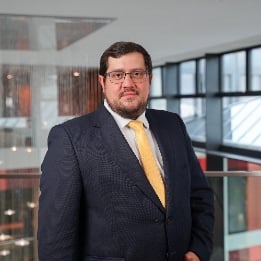
Antonio Benitez-Donoso
General counsel | EY
Team size: 6
What are the key projects you have been involved in over the past twelve months?
I suppose, as with many of my colleagues, the main topic has been how to sensibly incorporate new technologies, especially AI, into the legal team. In order to better prepare ourselves, we needed first to fully understand our models, our escalations and the different acceptable scenarios depending on the services provided. This has given us the opportunity to challenge ourselves and our business to write more effectively (and trim down in some cases) our legal terms to make sure they are as adjusted as possible. Once that exercise was finished, training and using the new tools was smoother.
Can you describe an instance where your legal advice directly influenced business strategy or commercial objectives?
It is very difficult to pinpoint a special instance. The way we work is intimately tied up with the business that sees us as more than a trusted adviser, a part of the team. Considering this relationship, we are involved from the beginning in launching new initiatives and tools. For example, when we started to use the support of AI tools, the legal department was quickly brought up into the working group to make sure that any project we considered or initiated came from the get-go with our full legal endorsement and expertise.
What key trends should in-house counsel be monitoring over the next six to twelve months?
The obvious answer is the use of AI, both by our internal clients, but also by our (external) clients and suppliers. The speed in which the technical world is developing does not follow the legislators and regulators and we need to make sure we correctly interpret any grey areas and substitute the regulator’s role in reaching understanding with our supplier or client colleagues. I also think that employment matters will be at the forefront during the next six to twelve months depending on the evolution of economic uncertainty.
As geopolitical instability continues, alongside economic and technological change, how do you guide your organisation through periods of uncertainty?
A major part of the work of guiding a company through conflicting times has to be done before the instability arises. That is why during “calmer” (if there are ever calm times as in-house counsel) it is important to build a robust legal team and process that supports the company when the tides turn.
How has the role of general counsel evolved, and what are the most important attributes for the modern in-house lawyer?
I would challenge the premise that the role of the general counsel has changed. I don’t think it has. We have to be, as we always were, the main trusted legal adviser. And that has not changed. It is true that the modern in-house lawyer will be expected to be more a “renaissance man/woman” considering the tools at our disposal, but the general counsel already had that nature.
How do you navigate situations where legal advice and commercial objectives conflict?
It is not easy. The phrase I like to say to my team is ‘we never say “no”, we say “not this way’. I think that there are hardly any topics that the only possible answer is “no”. There are instances where the proposed solution needs to be modified from a legal point of view, and there are cases where the leadership needs to take a risk-tolerance decision, and those are good enough as long as we have done our job of correctly advising the main stakeholder.
How have you implemented AI within your legal team to improve efficiency while maintaining quality and governance – and keeping the human element?
This is the billion-dollar question. For us, the arrival of AI has not changed the size of the team. We remain the same size as last year and double the size of two years ago. What AI has allowed us to do is to speed up the processes and to free up time to dedicate the extraordinary human resources to other topics that were, in the past, relegated due to the lack of time and resources. For example, the introduction of AI has first led us to a work intensive peak to ensure that we trained the AI in accordance with what we were expecting from it. To do that, we had to think about how we would answer potential questions and what could be acceptable or not depending on the matter. But once finalised, the team reduced the time dedicated to admin tasks and started to strengthen other areas and focus on full legal review and update of all internal policies.
Organisations are facing increasing regulation across jurisdictions. How do you embed compliance across the business?
In two ways: working closely with our risk management and compliance colleagues, but also with the support of the new tools. Monitoring and learning new regulations and monitoring and controlling compliance is one of the areas where, in my experience, AI tools have provided great support.
In which areas does compliance most commonly break down, and how do you address these risks?
We see that compliance is most commonly stretched when time pressures build up. When you are faced with a heavy workload and a tight timeline, this is when compliance breaks down. To avoid this issue, I believe that automating processes and simplifying the performance of compliance obligations reduces the time intensity of performing compliance tasks, and therefore helps avoid a compliance breakdown. Also, I have found that leading by example, both myself and other leaders, is the best way to promote compliance.
How do you promote ethical decision-making beyond formal compliance requirements?
Ethical values are a very personal matter. It is difficult, or impossible, to impose them on others. The only way I have found in my career to promote ethical decision-making is by leading with the values I ideally wanted to promote, and by supporting the leadership in communicating those values. One of the few areas where this can be actually shown is through the creation of a full ethical process: making sure that unethical behaviour is properly investigated and sanctioned is the best way to promote more people to come forward and challenge unethical behaviour, and make sure that, as a company, we don’t just talk the talk but walk the walk.
Beyond your legal role, is there a cause or initiative you are especially passionate about?
This work implies long hours, considerable pressure and a lot of challenges but, for me, it is a means to an end: my family. One of the hardest parts of the job is to “leave it at the door”, especially when the “doorbell” rings at 8 p.m. when you are home. That is why we are developing several internal initiatives, including the promotion of mental health in the workplace.
General counsel | EY
General counsel | KPMG Luxembourg
General counsel | KPMG Luxembourg
General counsel | KPMG Luxembourg
Head of legal and compliance | KPMG
Antonio Benítez-Donoso Tarascón started his career as a lawyer in 2004 at one of Spain’s largest law firms, Uria Menendez. After six months in the corporate department, he switched to...