News and developments
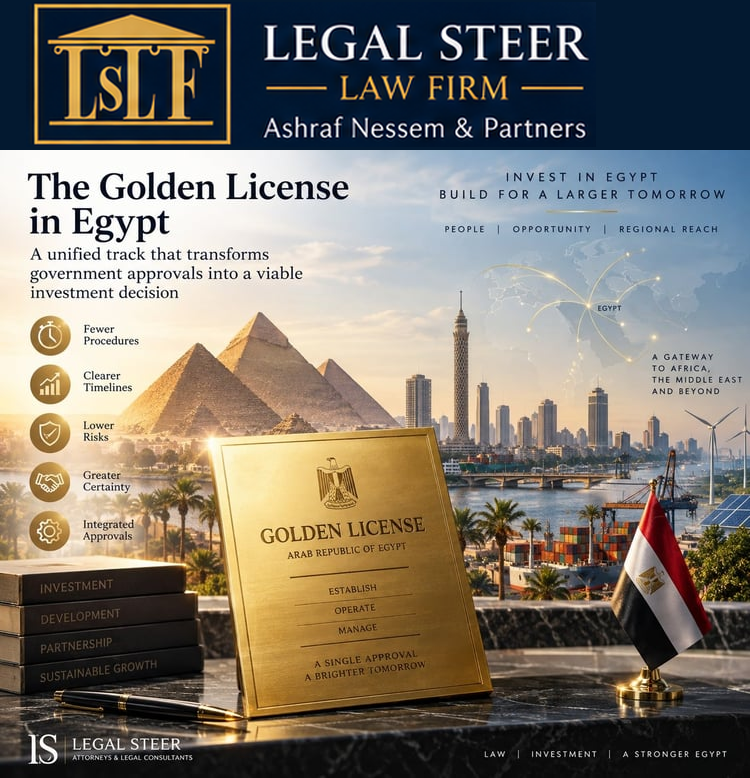
The Golden License in Egypt
The Golden License in Egypt
A Unified Track Turning Government Approvals into an Executable Investment Decision
Prepared by: Legal Steer Law Firm & Legal Consultants | September 2026
An investment decision in a new jurisdiction is no longer based solely on market size or operating costs. Procedural clarity and the ability to establish a reliable timetable for commencing operations have become key factors in assessing any project. Against this backdrop, Egypt’s “Golden License” constitutes an important legal mechanism for facilitating the implementation of strategic and national projects and reducing the multiplicity of authorities and approvals with which an investor may otherwise have to engage before commencing operations.
The true value of the Golden License lies not in its name, but in its legal nature as a comprehensive approval issued by a resolution of the Council of Ministers. It covers the establishment, operation and management of the project, including building permits and the allocation of the real estate required for its implementation. Within the scope specified in the resolution granting it, such approval is effective in its own right without the need to obtain further approvals.
A Legal Framework to Streamline the Investor Journey
The Egyptian legislature introduced the single-approval regime under Article 20 of Investment Law No. 72 of 2017, while Articles 42 and 43 of its Executive Regulations govern its conditions and procedures.
Under this regime, the Council of Ministers may grant a company a single approval for the establishment, operation and management of its project, instead of requiring those procedures to proceed separately before multiple authorities. Depending on the nature of the project and the terms of the relevant resolution, the approval may include the allocation of the required land, building and operating permits, as well as certain general, special or additional incentives available under the Investment Law.
Accordingly, the Golden License does not eliminate the role of the competent government authorities. Rather, it consolidates the outcome of coordination among them within a unified institutional track administered and followed up by the General Authority for Investment and Free Zones (GAFI).
Why Does the Golden License Matter to Investors?
Investors, particularly in large-scale projects, face a challenge that extends beyond obtaining each approval individually to the sequencing and synchronization of those approvals. Land allocation may depend on a technical approval; a building permit may depend on compliance with further requirements; and commencement of operations may depend on utility connections and sector-specific approvals.
The Golden License helps address this interdependence by bringing the project’s essential elements within a single framework. In practical terms, this may provide investors with the following benefits:
· Reducing the number of procedures and communications with government authorities.
· Improving the ability to establish a realistic timetable for project commencement.
· Reducing the risk that one approval will be delayed relative to other project components.
· Enhancing clarity regarding the project’s legal position vis-à-vis financiers, partners and contractors.
· Aligning land allocation and building and operating permits with the nature and actual requirements of the project.
· Providing the possibility of benefiting from certain investment incentives, where the applicable conditions are satisfied and such incentives are included in the resolution granting the license.
These advantages are particularly significant for foreign investors who, before committing financing, require a clear view of the land, utilities, licenses and expected timeframe for commencing operations.
Projects Eligible for the Golden License
The Golden License is not automatically granted to every investment project, nor is the amount of investment, by itself, sufficient to qualify. As a general rule, the project should be strategic or national in nature, contribute to sustainable development, and be consistent with the State’s economic development plan.
Its scope also extends to certain projects implemented through partnerships between the private sector and the State or a public-law entity, particularly in the fields of public utilities, infrastructure, new and renewable energy, roads, transportation, ports, telecommunications and information technology.
In assessing the strategic importance of a project, its economic and developmental impact is considered as a whole. Factors that may support an application for a Golden License include:
· Increasing exports or providing products capable of competing in foreign markets.
· Substituting domestic production for imports and increasing local content.
· Transferring modern technology and localizing industrial and technical know-how.
· Providing strategic goods and reducing dependence on imports.
· Creating genuine employment opportunities and training Egyptian workers.
· Establishing the project in an area with greater development needs.
· Supporting the green economy, reducing emissions and improving resource-use efficiency.
Accordingly, the project file should demonstrate from the outset the value that the project will add to the Egyptian economy, rather than merely stating its capital investment or anticipated production capacity.
Egypt as a Base for Regional Expansion
The appeal of the Golden License is linked to the broader advantages of the Egyptian market. Egypt’s geographic location enables industrial, logistics and service projects to access markets across the Middle East, Africa and the Mediterranean, while its domestic market provides a broad consumer base and growth opportunities across diverse sectors.
Investment opportunities are particularly notable in renewable energy and green hydrogen, food, pharmaceutical and engineering industries, automotive components, transportation and logistics, infrastructure, telecommunications and information technology, waste management, water desalination, tourism and urban development.
The Golden License may therefore serve as more than a mechanism for accelerating approvals; it may provide an entry point for establishing a production or service hub that serves the Egyptian market and expands from Egypt into regional markets.
How to Build a Strong Application File
The application process begins through the unit responsible for the Golden License at the General Authority for Investment and Free Zones. The unit reviews the application, verifies satisfaction of the applicable conditions, identifies the land, licenses, approvals and incentives associated with the project, and coordinates with the relevant government authorities before submitting a compliant application to the Council of Ministers.
The strength of an application does not depend solely on completing formal documentation. It also depends on the investor’s ability to present a clear and executable project. It is therefore advisable for the application file to include:
1. A preliminary feasibility study prepared by a qualified consultant, setting out the target market, production volume, financing and economic return.
2. A clear financing structure and sufficient evidence of financial capacity.
3. A realistic timetable for the stages of project establishment and commencement of operations.
4. A precise statement of the required land area, location and utility requirements.
5. A statement of the project’s impact on employment, exports, local content and technology transfer.
6. An inventory of the sector-specific, environmental and technical approvals associated with the nature of the activity.
7. A clear outline of the company’s structure, governance, management and the ultimate beneficial owners of the investment.
The more coherent these elements are, and the more they are supported by verifiable documentation, the easier it will be for the competent authorities to assess and coordinate the project.
What the Golden License Does Not Mean
It is important to distinguish between streamlining licensing procedures and exemption from legal obligations. Obtaining a Golden License does not exempt a project from compliance with the rules governing its activity, nor does it remove obligations relating to environmental protection, competition, employment, taxation, customs, occupational safety and health, or import and export requirements.
Nor should the Golden License be regarded as an automatic guarantee of entitlement to all incentives provided under the Investment Law. The scope of available incentives depends on the nature of the project, satisfaction of the conditions applicable to each incentive, and the terms of the Council of Ministers’ resolution granting the license.
The Golden License likewise does not replace legal due diligence concerning the land, project contracts, intellectual property rights, financing, supply or construction arrangements. A comprehensive administrative approval reduces procedural risk, but it does not eliminate the need for sound legal and commercial structuring.
Legal Planning Precedes Submission of the Application
A project may lose valuable time if an investor applies for the Golden License before defining its requirements or completing its legal and financial structure. The effective use of the regime therefore begins before submission, through a preliminary assessment of the project’s eligibility and identification of the elements that support its characterization as a strategic or national project.
This includes reviewing the company’s legal form, source of financing, status of the land, sector-specific and environmental requirements, implementation timetable, requested incentives, and the project’s alignment with the State’s development plans and priorities.
The company should also identify precisely what it seeks to have included within the comprehensive approval. Drafting the application in overly general terms, or leaving essential project requirements to a later stage, may reduce the practical benefit that the Golden License is intended to provide.
A Practical Step Toward a More Efficient Investment Environment
The Golden License represents a shift from administering each license as a separate procedure to treating the investment project as an integrated economic unit. This shift is particularly important for projects requiring land allocation, building and operating permits, and coordination among a large number of authorities.
However, an accelerated process does not dispense with the need for high-quality preparation. A project supported by a realistic feasibility study, clear financing, an executable timetable and measurable economic impact will be better positioned to benefit from the single-approval regime.
For investors seeking a production or service base strategically located between major regional markets, Egypt offers a combination of geographic location, market size, sectoral diversity and development opportunities. The Golden License adds a particularly important element to that combination: a unified institutional track designed to help turn an investment decision into an executable project.
Disclaimer and Official Sources
This article has been prepared for general information purposes only and does not constitute legal advice in relation to any specific project. The rules and requirements in force at the time of filing should be verified by reference to the nature and activity of the relevant project.